

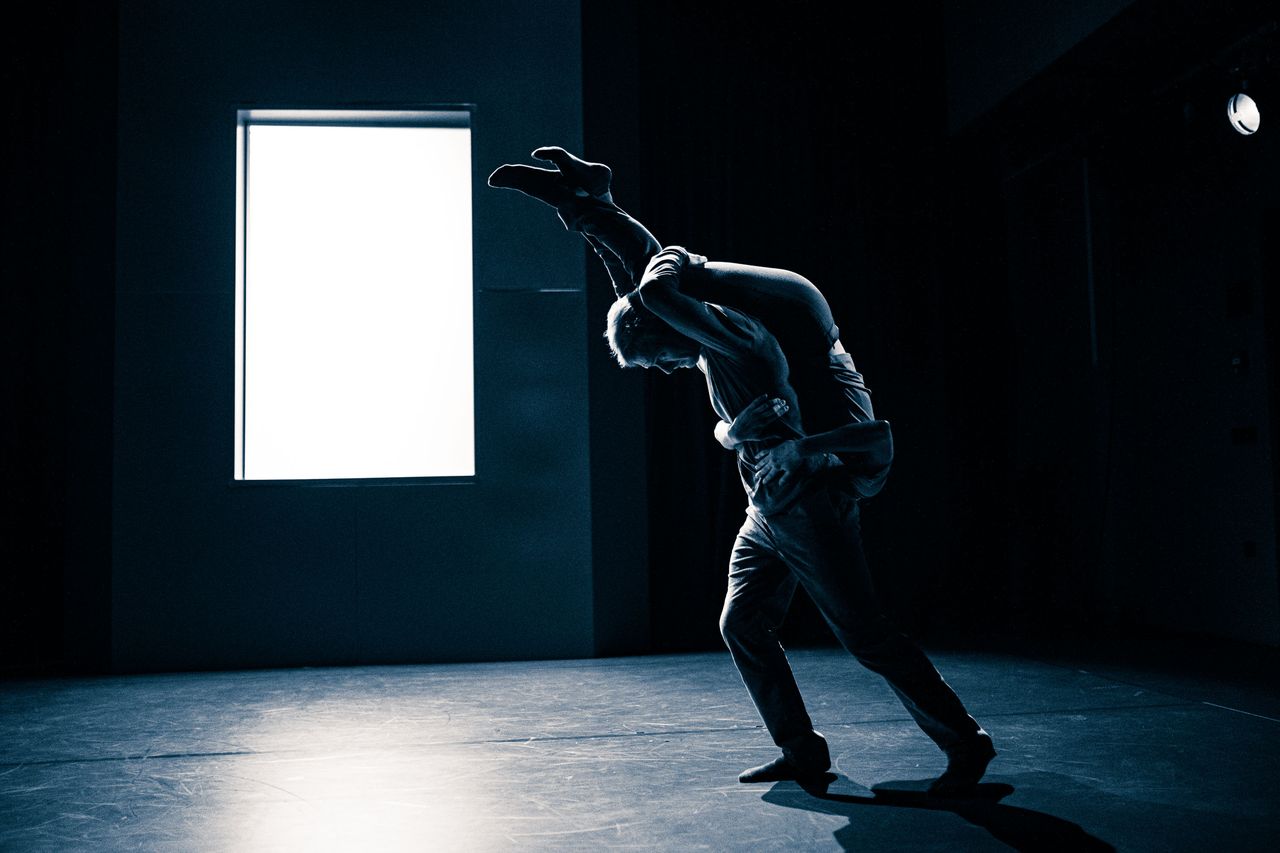
Short Cuts
Production company / Theatre: Anton Podbevšek Theater
Original title of the performance: Kratke zgodbe
Title of the performance in English: Short Cuts
Country of origin: Slovenia
Duration (minutes): 75
Playwright / Author: Tevž Logar, Filip Mramor, Luka Bokšan, Andrej Tomše
Director: Sanja Nešković Peršin
Full cast list: Mateja Železnik, Luka Ostrež, Filip Mramor, Luka Bokšan, Andrej Tomše
- Full artistic/creative team:
- Dramaturg: Tevz Logar
- Composer: Saso Kalan
- Set designer: Atej Tutta
- Costume designer: Uros Belantic
- Lighting designer: Jaka Simenc
- Video designer: Atej Tutta
Short synopsis: The conceptual starting point for the reflection on the play is the short story Two Kings and Two Labyrinths, by the Argentine writer Jorge Luis Borges, in which he establishes a tension between the world of matter and spirit – between the stone labyrinth, the brilliant architecture of human intelligence and arrogance, and its opposite: the divine labyrinth, a desert, infinite and uncontrollable.
Short Cuts by Sanja Nešković Peršin unfolds like a walk through an exhibition that poses questions about the entrapment and traps of contemporary life. Each scene has a conceptually independent effect, as an artifact of a moment in which our struggle, our longing, and our knowledge are reflected. And yet these images merge into a unified narrative: into the path of the protagonist wandering through a labyrinth, where each section hides a new trap, a new mirror of time, in which our relationship to freedom, love, rebellion, desire, control, violence, and feelings is refracted. The labyrinth is thus not just a stage that the viewer observes from a distance, but a sequence of spaces that unfold as a startling reflection on our everyday lives. The path is not designed only horizontally, but also vertically, which is subtly evident primarily from the visual design of the performance. Each scene establishes a moment – whether momentary or long-lasting – a kind of reminiscence of the rules, relationships, and ruptures that have occurred in the field of art and that today determine our relationship to it. In this way, the vertical path becomes a kind of immaterial labyrinth through which the viewer travels alone, in the desire to recognize the hidden visual moment. Through the stories, performers create a tension between the material and the immaterial: the horizontal path appears as a metaphor for the labyrinth of our modern traps, while the vertical unfolds as the final space in which all human attempts at control fail. Perhaps it is precisely where direction is lost that the possibility of freedom emerges – a tiny but invaluable step out of the labyrinth.
Tevž Logar