Showcase - Sarajevo Theatre Showcase
Showcase >>>
Kockica Showcase
Selection Committee
Beka Vučo
Ulricha Johnson
The Machine
Suicide as a social fact
This is my truth, tell me yours
Prishtina. The premeditated killing of a dream
Hinkemann
Podroom

Showcase

A series of closed presentations featuring up to ten recently produced regional theater productions, presented to carefully selected industry decision-makers. This format connects theater makers with international programmers, festivals, and producers, offering early access to some of the most exciting new works from Southeast Europe. The Showcase will be taking place from the 12th to the 14th of September.

WIP 80

Residency Critics

This section presents five critics who took part in the Critics/Reviews program. Each offers a short reflection on their experience during the residency.

Ana Matic

Suicide as a (social) fact, The Machine and This is my truth, tell me yours at Sarajevo Theatre Showcase (2025)

Ana Matić

Is the Need to Share Ones Story a Sufficient Reason to Create a Theatrical Performance?

I left the theatre feeling uneasy. Three times in a row.

Maybe these performances simply aren’t for me, I thought. I was fully present, focused, wanting to listen carefully to each woman on stage as they spoke to me directly and honestly, to hear their stories and empathize with them. I really did. But I couldn’t. Until now, that had never been a problem for me.

I understand that artistic work can be a therapeutic tool. I use it that way myself. I know these women on stage return to their traumas and fears each time they perform these shows. They speak their truth loudly because it is too heavy to carry alone. I see the honesty and vulnerability in theirperformances.

I see it, but on each occasion, I still left the theatre feeling indifferent, disappointed, even angry. Their call for empathy didnt reach me. Instead, it left me feeling denied my own theatrical experience.

Where is my catharsis, I asked myself? Why couldn’t I reach it?

This failure is something I wanted to explore in this review.

The first piece in the showcase, was Suicide as a (social) fact, directed by Serbian director Ana Janković.  At first, we are inside a woman’s apartment, witnessing a scene of raw intimacy of a womans daily life. She is no different from any of us. We follow the last few minutes of her everyday routine that leads to her suicide. The beginning of the show is slow, gentle, and naturalistic, asking the audience to fully focus and be present. But when actor Iva Ilinčić says that all this will end in suicide, the piece quickly changes. It becomes an ad hoc spectacle, like a show for distraction.

The whole artistic team, including Janković, appears on stage in exaggerated, ironic costumes. They start a kind of stand-up show, ready to entertain and shock to meet the large and hungry demands of the audience. By employing a variety of provocative and sensitive themes, dramatic and performative tools, as well as a free, associative flow that pushes the performance’s dynamics and concept to a boiling point of audience reactions, they escalate the energy to its limits.

Their symbolic choices are clear to me, but framed as a “political performance,” as they explicitly define it themselves, all the employed elements nevertheless remain at the level of producing the fastest and strongest audience reaction, rather than being used in a deeper way to create the sociological and psychological atmosphere that is, in fact, the reason for the performance.

I didnt feel comfortable being part of this audience—and it seems many others didn’t either. How did I become the antagonist here? I felt offended because the show suggests that I am shallow and capitalist in my view of theatre. It blames me for the fall of classical theatre values, which made these artists unable to create noble and brave moral stories. Instead, they use vulgarity as their only way to get attention. Though at times, in breaks between the chaos, we see the fragile private lives of young artists struggling with a broken system and changing social values, trying to survive without betraying their art, the feeling of connection is missing. The close relationship with the audience is not supported or encouraged; instead, the show is designed to get quick reactions.

Moving on to the next piece The Machine by Bojana Robinson, a choreographic work interspersed with subtle, yet somewhat fragmented and hermetic dramatic sequences. It tells an intimate story about learning to live with a machine that helps her child to breathe. In the beginning, Robinsonbecomes a gentle narrator, her words cradle the audience. She invites us in, to listen, to empathize. Unfortunately, the slow and repetitive movement dynamics that exquisitely exhaust and beautify express the authors own experience, soon drain the audiences attention, hindered by the absence of the anticipated verbal or overt dramatic exchange. The story remains only partially apprehended. By choosing theatre as a form yet not pushing its boundaries toward participatory or collective engagement, the piece remains locked in self-reflection.

The final performance, This is my truth, tell me yours by Croatian dramaturg Jasna Žmak, operates within the dramaturgical framework of text and narration, gradually unveiling Žmak’s personal truth through charming writing and direction.

Žmak leads her performance with organic immediacy, playfully manipulating dramatic causality and conventions, deftly constructing a comedic foundation beneath a deeply serious and touching story. The audience here is not just a witness to Žmaks testimony, they are participants in creating the meaning of the events, playing an essential role in reconstructing the events that become the authors truth – how an ordinary theatre visit turned into a 13-year battle with tinnitus.

This performance raises an important question (that I also wonder about): What are the limits of the authors responsibility regarding audience participation? Unfortunately, even with an awareness of the special and sensitive space that is built between performer and audience in this piece, based on the authors ethical message from her own experience, catharsis is still missing. I think this is because the story moves quickly, trying to keep a light, entertaining tone. Although the author, at moments, plays with various familiar, even slightly caricatured forms of establishing a relationship with the audience – by asking questions, inviting spectators onto the stage, shifting focus to the auditorium instead of the stage, and so on, she never carries these gestures through to the end. They remain teasers of what could have created a closer and more committed relationship between the performer and the spectator.

In all three cases, I found the same unresolved tension: a desire to provoke audience empathy through intimate storytelling, without truly activating or sustaining a relationship with that audience. I believe this is not merely a matter of staging or taste, but a deeper issue of genre, or more precisely, of not fully embracing the form through which the story is told.

Could another artistic form have offered a safer or more adequate space for these confessions? Possibly. Especially, forms that ask less of the audiences real-time emotional presence and vulnerability. And yet, I understand the choice of theatre. Because theatre can provide a space of collective healing, shared breath, and immediate human connection. But only if we dare to fully open it up, not as a stage for symbolic exposure, but as a place of true encounter. And that, I fear, did not happen here. They did not explore, or perhaps, did not trust, the full range of theatres potential for co-presence, exchange, and vulnerability.

After each of these performances, I departed resentful, not because I didn’t like them, but because the intimacies they invoked were left for me to carry alone. Who is responsible for the questions, the self-reflections, the unease they provoked in me? I longed for conversation, an embrace, a space to share the emotional weight. Instead, I felt abandoned.

Returning to my first question: Is the need to share ones story enough reason to create a performance?

Yes—but only if it is accompanied by an awareness of what theatre, as a medium, demands in return. Theatre is not therapy, even when it borrows its tools. It is a collective space of intention, responsibility, and exchange. To enter someone’s intimate space must be done with care, it must include an invitation or at least a suggestion of the role the witness (the audience) is expected to play. The boundaries of intimacy must be shared, not imposed. Creating the conditions in which the audience can feel or accept those boundaries is as much an artistic task as crafting the content itself.


In this regard, I humbly offer a terminological and conceptual proposal for a theatrical/performative category, which would be more suitable for this type of content.

Collective Intimate Performance—an authorial work in which the needs of both performer and audience, the latter capable of participatory or even performative engagement, are mutually exhausted; a performance that deliberately abandons its dramatic structure to cultivate a collective cathartic experience; a performance that uses artist’s personal story not as the sole content of the work, but the starting point for a shared emotional and ethical experience; a performance that requires the creation of dialogic or participatory frameworks—be it through post-performance discussions, ritualistic closure, spatial redistribution, or dramaturgical openness that allows for affective response and exchange; a performance that places the human experience at its very centre.


Katerina

When Dreams Collapse: Reviewing Prishtina. The Premeditated Killing of a Dream

Katerina Markoska

PRISHTINA. The Premeditated Killing of a Dream is a story rooted in one city, yet it echoes the collapse of visions in countless others, turning hopes to ashes. Across the region, we all suffer the consequences of the same root cause: careless planning, uncontrolled construction, poor oversight, and the frailty of what is built in imprudence. This production tells a bold story, deeply familiar to us in the Balkans, with clarity and rawness that strikes at everyday life. I attended this production during the Sarajevo Theatre Showcase at the Sarajevo National Theatre.

The play, produced by Qendra Multimedia, is written by Jeton Neziraj and is the updated version of In Five Seasons: An Enemy of the People, originally staged in 2019. In this new form, PRISHTINA. The Premeditated Killing of a Dream, which premiered in 2025, Neziraj revisits and sharpens the story. While the earlier version left certain details unsaid, here architect Rexhep Luci is named directly, one of the changes that give the play greater weight and impact. At its center is Luci himself, head of spatial planning in Prishtina, whose efforts to protect the city’s urban vision brought him into direct conflict with criminal construction networks. His story has tragic weight: he was assassinated on 11 September 2000 in Prishtina, a fact that makes the play feel all the more vital. The text shows bold dramaturgy – direct and incisive, yet layered enough to sustain attention and to make the political resonate through the personal.

The narrative unfolds through five characters: the architect, his daughter, Pierre (a UN employee), Meti (the owner of the construction company Liberty), and the Trade Union Leader. While the events progress in a linear fashion, they are frequently interrupted by the actors, who step out of character in the spirit of Brecht – breaking the illusion in order to narrate and comment on the events and the wider situation in the city. This structure, both straightforward and fractured, is a deliberate dramaturgical choice, keeping the audience alert while preventing an easy immersion into illusion.

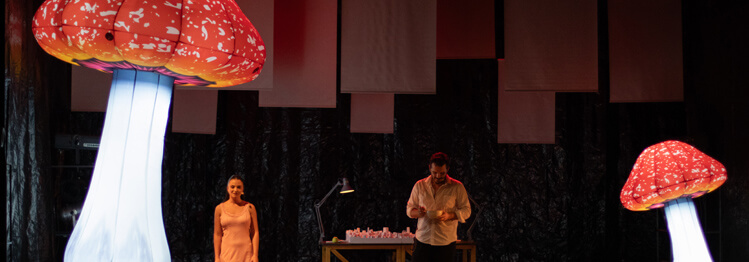
When the audience enters, the actors are already in place – some on stage, others seated in the front row of the auditorium. Throughout the performance, this row functions as both an entrance and an exit, yet the actors never truly leave the stage. At one point, the row itself becomes part of the stage, blurring the line between audience and performance. At the center stands the architect’s worktable, bearing a model of the city shaped by his vision. Above him, screens project images of Prishtina – haunting reminders of the consequences and of what he ultimately failed to prevent. The set, designed by Alice Vanini, frames these elements with precision, shaping a stage world that supports both the play’s realism and its more dreamlike passages.

Two scenes where new elements or shifts in scenography are introduced prove especially captivating. In one, a camera attached to a pair of glasses captures a live interview, performed in the front row and simultaneously streamed onto the screens – like a television broadcast. This moment challenges our ability to process information on multiple levels at once. Towards the end, the daughter’s dream scene creates a magical space where she is able to meet her father once more.

The costumes, realized by Njomza Luci, anchor the play in a sense of everyday truth. They feel authentic to the environment the story depicts, blending with the world on stage. Only Pierre, the UN employee, stands apart in his outfit – a casual robe-like costume that might seem unusual for such a figure. Combined with his performance, it sharpens his portrayal as both an outsider and a hypocrite.

The music by Tomor Kuçi is used only at selected moments, each time with clear effect. It helps shape the atmosphere, hinting at the situation on stage, and in the final song it adds a touch of sadness that stays with the audience as the story closes.

The ensemble of five actors – Armend Smajli, Verona Koxha, Shpëtim Selmani, Kushtrim Qerimi, and Afrim Muçaj – is a strong selection, each well-suited to the part and true to the story. Armend Smajli, as the architect, brings quiet dignity, a figure calm and steady, but firm in his beliefs. Verona Koxha adds lightness to the daughter, while also conveying her underlying worry, becoming a channel through which her father’s inner world is revealed. Shpëtim Selmani sharpens the critique with irony and detachment, capturing Pierre’s hypocrisy as an outsider. Kushtrim Qerimi embodies the construction tycoon with unsettling precision: a figure one cannot trust, blunt and repulsive in his pragmatism. Afrim Muçaj, as the Trade Union Leader, portrays an honest citizen torn by worry for his future, easily persuaded to shift sides, and thus representative of a fragile social conscience. Together, their performances sustain a sense of sincerity, keeping the story grounded in the world we recognize.

The direction by Blerta Neziraj remains close to the text, without imposing additional layers onto the story. This choice gives weight to the subject matter itself, allowing the narrative to speak with clarity and reach a broad audience. The actors’ performances are natural, never overplayed, which reinforces the overall realism of the staging. What may seem at first a straightforward approach gradually builds in intensity, and by the final scene the emotional resonance becomes undeniable. The closing moments touched me deeply and moved me to tears—a proof that Neziraj’s vision, while subtle, was carefully calibrated to let the story grow in force as it unfolded.

Prishtina confronts us with an almost eternal dilemma: is it worth risking everything – even one’s life – for an idea, for defending what is believed to be right? Rexhep Luci emerges as both a voice of warning and a stubborn dreamer, carrying echoes of Ibsen’s Dr. Stockmann, the uncompromising truth-teller who refuses to stay silent, and of Don Quixote, the idealist who fights battles that may already seem lost. History has given us many such figures, men and women who sacrificed themselves in the name of principle. But the weight of the play does not rest only on the individual – it falls on us, the audience, the society. It asks whether we are willing to hear such voices, to let their courage stir us, or whether we will once again allow them to fade into silence. In this way, Prishtina becomes more than a story of one city: it becomes a question directed at all of us.

Credits:
Director: Blerta Neziraj // Actors: Armend Smajli, Verona Koxha, Shpëtim Selmani, Kushtrim Qerimi, Afrim Muçaj // Set design: Alice Vanini // Costumes: Njomza Luci // Composer: Tomor Kuçi // Choreographer: Gjergj Prevazi // Video: Besim Ugzmajli // Ass. Director: Gëzim Hasani // Art Director: Aurela Kadriu // Researcher and artistic collaborator: Agron Demi & Instituti Atlas // Dramaturg: Jeton Neziraj // Dritat: Mursel Bekteshi // Development support: Sven Skoric // Translator: Alexandra Channer // Coordination: Flaka Rrustemi // Technical support: Bujar Bekteshi, Adem Salihu, Nikolas Pipero, Arbresha Caka, Njomza Rexha.

Nikola

WHAT IF A MACHINE BECOMES PART OF THE FAMILY

Nikola Stanišić

Although the title suggests performance might be about the end of the world or an impending apocalypse brought by the rise of artificial intelligence, it is, in fact, something deeply personal—something that burdens the performer and which she chooses to share with the world through the framework of stage performance. The question arises: is this the right way of addressing a personal problem, or does it belong elsewhere, in another kind of institution, approached through art or perhaps less artistically?

On the second day of the first Sarajevo Theatre Showcase, at the Youth Theatre Sarajevo, Bojana Robinson, in collaboration with dramaturg Dimitrije Kokanov, presented the performance The Machine. In the first third of the piece, performer Robinson enters the stage wearing a skin-colored costume, introduces herself, sits on a chair to the side and begins to read a prose text from her phone. While the desert images flicker on a slideshow behind her, one slide shows a crashed car. When a certain altitude is reached, there is no air and people do not finish their journey. The introduction does not promise a happy ending. Robinson does not attempt to deliver the reading dramatically; rather, she reads without pauses or emphasis. Through this text she symbolically conveys that her child is a flower in the desert. As already indicated, this is a personal story. Later, Robinson shifts from symbolic narration to direct confession: in an open, candid monologue, she tells the audience that her daughter must rely on a machine that concentrates oxygen. What if machine becomes family? This condition has changed the life they once had. They cannot go anywhere without the machine; it has become a new member of the family. At one point Robinson reveals that they have never visited England, where her husband is from, because the machine cannot travel by plane.


This theme is staged in the second third of the performance. Robinson crawls toward the machine but cannot reach it. The crawling repeats, the distance between her and the object growing, her movements condensed and repetitive. At first it seems easy, but as time passes, sweat appears on her face, her breathing grows heavier, her tied-up hair comes undone. The emotional intensity rises, and the audience is drawn in. The Machine and Robinson are, at this moment, opposite poles of a magnet. The more they strive to unite, the further they drift apart. In the end, she reaches the machine—worn out, yet her face radiates triumph.


At a certain point, Robinson puts on blue shorts, the same color as the machine. They gradually become one. She demonstrates this on stage. She uncoils the cable—without which the machine cannot operate—and drags it into the depth of the stage. Lying down on the floorboards, she begins to make love to the machine. The impossibility of achieving pleasure is visible, painful. She goes around in circles, yet never reaches satisfaction. She lends the machine the voice of Medea, speaking with it, though here the context feels misplaced. A monologue of another female figure, someone with a different fate than a woman who killed her children after being betrayed by her husband, would perhaps have been more appropriate. What until then seemed like a plastic representation begins to take the shape of torment. She begins to carry the machine like a suitcase, but she stands still—its weight prevents her from moving. She tries again and again. The machine yields. Robinson lifts it above her head. The machine consumes her thoughts. There is not a single moment in her life that does not involve the machine. She cannot make love to her husband, she cannot spend time with her daughter, without carrying the machine with her. Every step is accompanied by the sound of rolling wheels. 


As the author of the piece, Robinson then projects a video on screen—a popular unboxing clip—through which she explains the machine’s components and its use. Now that everything is clear, that we understand what the family and she herself go through, the performance moves into its finale. Robinson merges with the machine, they become one, a new hybrid being. She sits on the machine and slowly fades behind it, using her shorts to simulate a head. The performer shows that she accepts this way of life, not as an obstacle, but as an integral part of it.


Robinson turns off the machine, and the performance is over, while a few machines remain on stage as a reminder that they are her eternal companions. Yet the lingering question is: does such a performance belong in the theatre, or could it be reshaped into something else? Can it truly resonate with groups who do not share a similar experience? This staging obliges the audience to sympathize with the author—but how deeply do they truly understand her?

Matea

Suicide as a Social Fact, STS performance - A Critique

Matea F.

Suicide as a Social Fact, by Ana Janković, is an ambitious work that sets out to confront one of society’s most urgent and painful issues. Its opening act offered a hauntingly realistic portrayal of despair and disinterest, delivered with restraint and insight. Yet the second half of the play abandoned this subtlety for chaotic spectacle, piling abstraction upon abstraction until the subject of suicide was nearly lost. While the courage to tackle such a theme is commendable and necessary, the execution left the audience more alienated than awakened.

The first part of the play was, without exaggeration, extraordinary. With minimal dialogue, a lack of facial expression, and no reliance on dramatic monologues, it managed to show what depression so often looks like in reality. On stage, we saw a young woman going through her nightly routine: quietly arranging roses in a vase, smoking while scrolling through TikTok, preparing dinner with indifference and eating it, then sitting in the living room to watch pornography with a monotonous expression and a cigar in her mouth, switching it off, then turning to a documentary about Australia, brushing her teeth, and so on.

The monotony was deliberate and powerful, showing a life drained of meaning. Dialogue appeared only through fragments of social media voices, creating the sense of a life surrounded by noise yet devoid of connection. The silence broke when the actress (Iva Ilinčić) finally spoke. She revealed that the character she is playing, at the end of her routine, went to the bathroom, took a bottle of Xanax pills, came to the living room, lined up twenty of them in two rows, took a bottle of wine and drank them all one, by one. She then described how slow a death by Xanax actually is, how it takes many hours for the body to shut down, and which parts of it fail first. The person is literally dying slowly, she explained, echoing not only the reality of the overdose but also the truth that suicidal people are already “dying slowly” long before any physical attempts.

The act closed with her describing how, after death, the body decays, and leaves only bones, which eventually turn to dust, while taking a small bucket filled with it and then pouring it all over the floor. This hauntingly simple gesture demonstrated the production’s capacity for honesty, restraint, and deep emotional insight. It set the stage for what could have been a masterpiece.


The second part of the play, however, shifted into an entirely different register. A man in a glittering red tuxedo appeared at the piano, followed by the actress dressed in a golden jacket, heels, and a short pink wig. The restrained realism of the first part gave way to a surreal circus of flashing lights, chainsaws, clown-like costumes, and chaotic monologues. At one point, in the beginning of this second part Iva starts unpacking a hand-bag, putting stuff from it on the piano, one of them being a framed picture of Fyodor Dostoyevsky, and an iron that had hard flashing lights, which she started to flicker on and off, while pointing them towards the audience. The effect was overwhelming, so much so that I had to close my eyes to ward off a migraine. Without any warning beforehand, such choices risk excluding or endangering audience members sensitive to light, including those with epilepsy. It is important to note that this responsibility, of warning the audience, should also have been taken on by the theatre in which the play was performed.

Iva’s performance reflected the shift with striking intensity. In the first part of the play, she embodied hyper-naturalism, with her minimal gestures and flat affect, she magaged to captue the exhaustion of depression and weight that it carries, with unsettling precision. In the second part, however, she transformed into something exaggerated, flamboyant, and grotesque. While this demonstrated her range as a performer, the suddenness of the transformation contributed to the sense of rupture, and instead of it feeling like a natural progression of the story, it heightened the impression of two unrelated performances stitched together.


This shift from the first to the second act was clearly deliberate. Stand-up bits, songs, taunts, grimaces, and text projected onto a screen all sought to show a society obsessed with consumption and unable to stop. At one point, the actress even declared that the audience had not come to sit in silence, that what they wanted was drama, entertainment, a show. The intention was clear enough, but in practice, it felt more like the production was blaming its own audience for “wanting it” and instead of exposing the social mechanisms behind suicide, the performance itself became a spectacle, mirroring the very thing it sought to condemn.

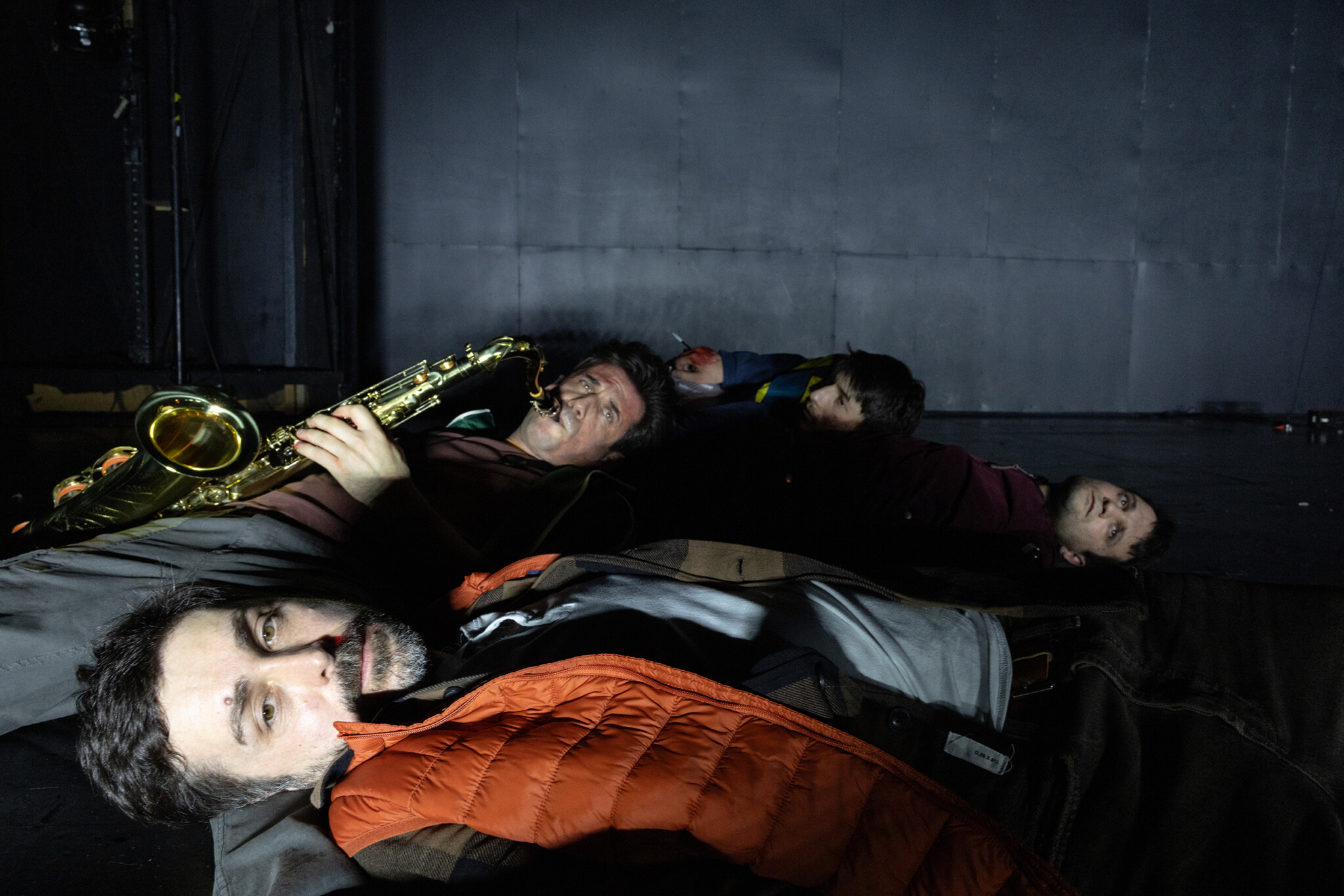
As the act progressed, it grew increasingly fragmented. Dostoevsky’s portrait rang with a phone call, leading into monologues from his novels. Patriotic songs about Tito and Yugoslavia were sung. Autobiographical stories from the cast and crew about unemployment were performed in the style of awkward stand-up comedy. At one point, the director, Ana, started saying This is my final show. After it I will kill myself. Later, the actors sang California Dreamin’ by The Mamas & Papas, with the explanation that this was a song used in Igor Vuk Torbica’s play Hinkemann. What they failed to clarify was that this was Torbica’s final production before his suicide at age thirty-three, the same age that Ana Janković is now, and the line she kept saying earlier was a reference to that as well. This is something they assumed their audience will know, which didn’t turn out to be the case with most people in it.


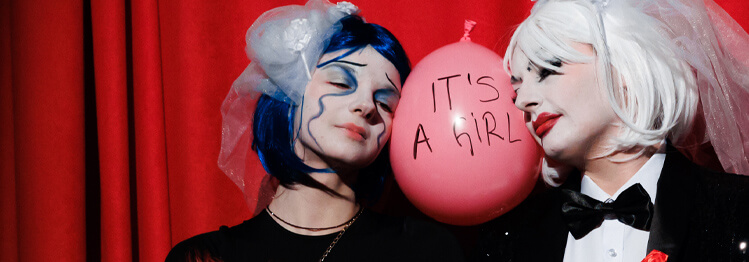
The dramaturg, Anja Bilanović, also appeared on stage during the second part of the play. Like Ana, she wore a clown-like costume, with heavy make-up, a short blue wig, and a sleek black suit. Her presence blurred the line between author, dramaturg, and performer, yet the role she played within the performance was somewhat ambiguous. She was introduced to the stage, through a joke about her professional path (that after completing her studies in dramaturgy she had “found work” in the theatre, selling tickets). Later, as the play progressed, she often moved into the background, assisting with props (such as holding a large Serbian flag during one of Iva’s monologues) and serving as a silent stage presence. It was not entirely clear whether this was something that was intended o serve as a commentary on the often-overlooked position of dramaturgs within theatre, or whether it resulted from weaker planning of character functions in the overall structure of the performance.

And despite the title’s emphasis on “social fact,” the focus in the second part became oddly narrow, circling Serbian political history and theatre-community struggles rather than the wider issue of suicide. The subject was reframed as a national problem instead of a universal one, diluting the urgency and reach of the theme. What remained was a patchwork of spectacle, leaving no clear conclusion.


As someone who was the person from the first part of the play, this shift felt not only alienating but enraging. The subject of suicide, so carefully and sensitively handled at first, was drowned in spectacle, mockery, and self-indulgence. Perhaps this critique of the second part is too harsh, because the theme hits a little too close to home; it is difficult to separate artistic judgment from lived experience when the subject matter is so personal. Even so, the effect remains the same. The communication between author and audience was fractured. Without the verbal explanations given on stage and the written description on Bitef’s website, the second act would be nearly incomprehensible. For many, it amounted to chaos for chaos’s sake. For vulnerable viewers, such an approach risks not only confusion but real harm.

The first act proved that intimacy and subtlety can carry this theme with honesty and force. The second act, however, would have benefited from greater clarity and focus. Abstraction can be powerful, but only when tethered to the central theme rather than scattered across politics, autobiography, and spectacle. Suicide is not only a Serbian issue, nor should it be reduced to a national context. Its reality crosses borders, generations, and communities, and it deserves treatment that reflects that universality.


All in all, the ambition behind Suicide as a Social Fact is undeniable, and the willingness to confront such a painful subject is commendable. Yet in its current form, the play risks leaving audiences confused rather than transformed, alienated rather than awakened. Perhaps the harshness of this critique comes from how close the theme cuts to lived experience. Even so, discomfort on its own does not make for effective theatre; provocation must still serve the subject. In this production, the subject of suicide was ultimately overshadowed by spectacle and abstraction. Theatre has the power to shape conversations about what is often left unspoken. To do so, however, it must trust the power of intimacy, clarity, and respect, qualities that Suicide as a Social Fact possessed in its beginning but ultimately failed to sustain.

Berina

REVIEW: THE NECESSITY OF TALKING TO ONESELF (IN FRONT OF OTHERS)

Berina Musa

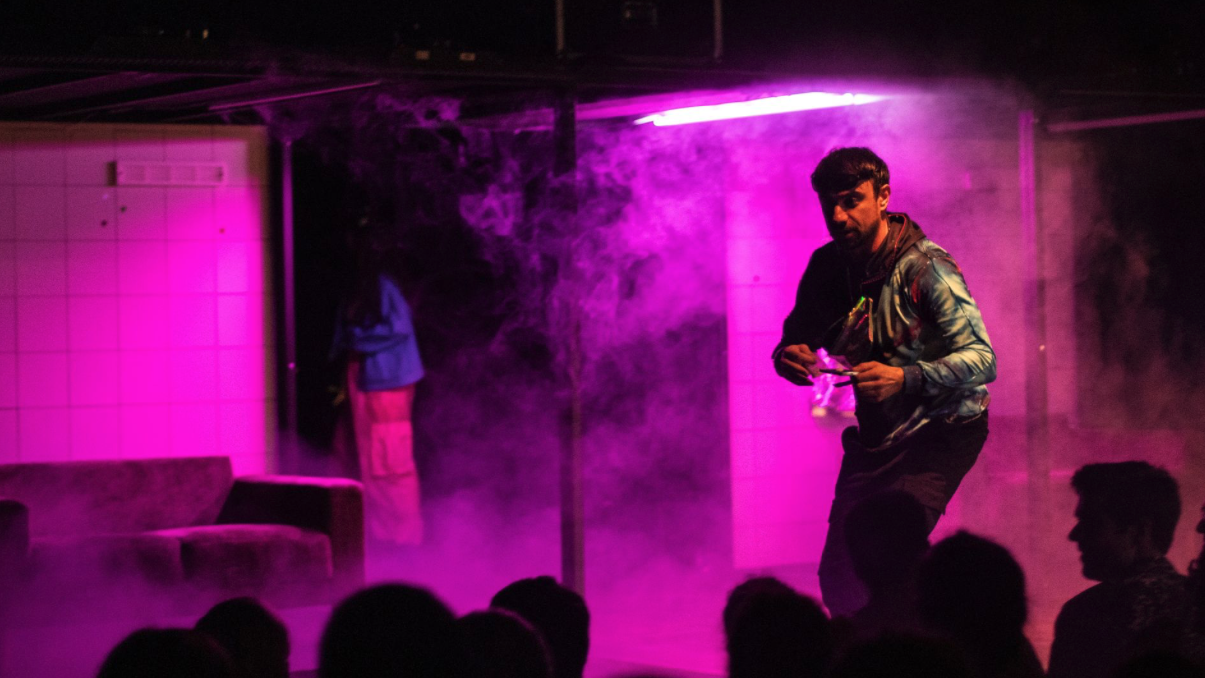
God is a DJ, and his name is Kosta. He is enthroned high above us, on an altar of metal and neon lights, tuning the techno beats on his mixing console.

Just before he raises his voice to preach to the crowd, a staggering flash of light strikes the disco ball above his head, leaving behind a nimbus-like crown to honor his holiness.

Then, with a tone vast and alluring, he whispers into the mic:

“I look at those lost and sweaty faces. And I see people who are finding themselves in the hope of receiving some kind of catharsis. And I like to believe that it is I who brings it to them. That tonight, I am your God.”

And so it begins.

“Podroom” is visually as spectacular as its opening scene. And more than that, it is a manifestation of intimacy, authenticity and artistic unity. In fact, everyone involved in the creative team behind this performance are renowned artists from Sarajevo’s local scene including Adisa Vatreš Selimović on scenography, Lejla Hodžić for costume design, Amila Terzimehić for choreography and Kemal Beganović on visuals, orchestrated by the visual artist Bojan Stojčić. The music is composed by the musical producer and DJ Mirza Rahmanović, better known as INDIGO. Every visual and acoustic element feels like a character in its own right – so vivid and powerful that it can feel overwhelming at times. Nevertheless, altogether they create an atmospheric space that immerses the audience completely, drawing them into the emotional and sensory world of the play and its struggling, partying characters.

Ajla Bešić’s directorial style rests on conceptual scenography and complex light design which, by focusing on the personal stories of young individuals, illuminates a necessity that remains rare in Sarajevo. While this approach might appear obvious – or even banal – to an international audience, it is crucial locally, where the theatrical scene still gravitates toward war and family tropes, often presented in an outdated realism tied to the Stanislavski school. Within such a context, young voices are still scarce, and younger generations of theatergoers struggle to identify with the stories and characters they see on stage. This is precisely where Bešić and the writer-dramaturge Armin Behrem intervene. Their interest lies in the loners, the misfits, the outsiders – in short, those misunderstood by the majority. This play is one of many collaborations between Bešić and Behrem. Both are alumni of the Academy of Performing Arts Sarajevo, where their artistic bond was forged.

Set in the nightlife of Sarajevo, the story unfolds between apartments and techno clubs, where intimate and public spaces intertwine, and the music is so buzzingly loud that one can barely hear their own thoughts, let alone the words spoken by the person next to them. This is where Behrem’s monologue-structure becomes strikingly effective. On stage, the characters mostly talk to themselves, sharing their fears and inner desires as if addressing a mirror in some quiet, dark place. More than that, it feels as though they are speaking through a wave of nostalgia, looking back on the events of the single night that the play depicts. Ishak, the main character, has the power to disrupt the storyline in order to set it right, revealing how things really happened – bringing the play to a metalevel that harmonizes perfectly with the metaphysical resonance of the music.

The characters in this play strip themselves bare. Refreshingly, not in the literal sense of taking off their clothes, but emotionally – down to the hidden place where the “duša” (soul) resides. There is Ishak (Faruk Hajdarević), who is in love with Kosta (Dino Sarija), and Marija (Anastasija Dunjić), who is in love with Baja (Edin Koja Avdagić). All of them are in relationships – some with each other, others with different partners. What initially seems like the plot of a simplistic love story reveals itself as the devastating reality of many among us. The impossibility of love as the highest level of intimacy has many reasons: economic and social, personal and public, clever and foolish, imagined and real. In “Podroom” it is a complex web that prevents the four individuals from being happy together with some of the main issues being homophobia, toxic gender roles, and unrealistic expectations of love. What results is violence as a response to these constraints, one that reflects not only individual cruelty but also the structural forces shaping them.

All four actors play their roles with captivating vigor, carrying the audience seamlessly through the 90 minute performance. Hajdarević delivers a character whose clumsiness and shyness evoke such endearing vulnerability that one roots for him immediately, as demonstrated in his final monologue, which moves the audience to tears. Sarija plays it cool, allowing his character only fleeting moments of fragility, and his subtle intensity heightens the heartfelt poignancy of Kosta and Ishak’s love story. Dunjić electrifies with her mesmerizing presence, commanding attention even in silence and a tenderness that lingers after the scene ends. Avdagić is uncompromising, embodying his character with raw honesty that never shies from discomfort. His outbursts of violence are not gratuitous, but expose how deeply the character is marked by the very constraints the play seeks to question.

Not only is “Podroom” a sensual feast, but a clear declaration to Sarajevo’s young artistic scene. By unifying renowned individuals from different departments, Bešić proves herself to be a visionary leader that before anything else values the importance of collective endeavour. In combination with Behrem’s strikingly outgoing writing style and an ensemble that successfully balances vulnerability with intensity, this performance is proof that Sarajevo’s stage can be both uncompromisingly local and unmistakably contemporary.